
San Mateo Silica Free Quartz Countertops News

The Cambria Silicosis Verdict: What a $17.45M Jury Ruling Means for Everyone in the Supply Chain
What was the Cambria Silicosis Verdict? On April 30, 2026, a unanimous jury in Denver, Colorado, delivered a historic $17,450,000 verdict in the case of Tyler Jordan and Caitlin Jordan v. Cambria Co., LLC, et al. 1 . This lawsuit represents the first artificial stone silicosis case ever filed in Colorado and only the third of its kind to reach a jury verdict in the United States 1 . The ruling has...

Silica Content by Countertop Brand: The Complete 2026 Guide
Not every countertop carries the same risk — and the brand name alone won't tell you the silica content. Crystalline silica content varies dramatically across engineered stone, sintered surface, solid surface, and natural stone brands. Some products contain up to 93% silica. Others contain zero. This guide breaks down every major brand — Caesarstone, Silestone, Dekton, Neolith, Corian, IceStone, B...

How to Display and Sell Silica-Free Countertops in Your Showroom (2026 Guide)
The global stone surfacing market is undergoing an unprecedented realignment dictated by escalating occupational health regulations and shifting corporate liability models. The regulatory landscape in North America has drastically tightened. If you are a distributor, the days of operating strictly as a raw material supplier are over. Regulatory changes mean the legal burden is moving directly up t...

Stainless Steel Countertops: The Complete 2026 Guide to Silica-Free Commercial and Residential Surfaces
Why Stainless Steel Is the Leading Metal Countertop Silica-Free Alternative Following the widespread implementation of strict regulatory bans on high-silica engineered stone to protect manufacturing and fabrication workers from silicosis, architecture and design firms are prioritizing silica-free surface options. 1 Stainless steel countertops represent the premier metal countertops silica-free sol...

California Votes to Ban Engineered Stone Fabrication
California's Occupational Safety and Health Standards Board voted 3-0 Thursday to direct Cal/OSHA to begin formal rule-making toward banning the fabrication and installation of engineered stone slabs containing more than 1% crystalline silica. If that rule-making results in an adopted standard, California would become the first U.S. state to prohibit the material by law. The board's conclusion: en...

Caesarstone Mineral vs. Viatera NeoQ: Q40 Low-Silica Quartz Compared (2026)
The OSHA and Cal/OSHA Rules Driving the Shift to Q40 Low-Silica Quartz The global engineered surfacing market is undergoing a structural transition driven by stringent workplace safety regulations and environmental mandates. Historically, traditional engineered quartz surfaces comprised 90% to 93% crystalline silica by weight. 1 However, the mechanical processing of these materials—specifically cu...
BioQuartz®: A Safer and More Sustainable Alternative to Quartz
What is Bioquartz®?
Bioquartz® is an innovative industrial material that is 100% free of crystalline silica. It is produced by subjecting regular siliceous and feldspar sands, or remnants from the slab manufacturing process, to a pyrolytic transformation, which involves melting these materials at approximately 1500°C. This process creates a material that possesses the same technical and aesthetic features as quartz, making it an ideal substitute in the production of engineered stone slabs [3].One of the key advantages of Bioquartz® is its safety profile.
Crystalline silica, a common component of natural quartz, is a known carcinogen that poses significant health risks to workers involved in the fabrication of quartz surfaces [5]. By eliminating crystalline silica, Bioquartz® provides a safer work environment and reduces the risk of silicosis and other respiratory illnesses[2]. Furthermore, there is a growing policy focus on restricting the trade of products with high crystalline silica content [4]. Bioquartz® offers a solution to comply with these regulations and provides a responsible alternative for manufacturers and consumers concerned about the health and environmental impacts of crystalline silica.
Technological Applications of Bioquartz®
The primary application of Bioquartz® is in the manufacturing of engineered stone slabs. These slabs are widely used in countertops, flooring, wall cladding, and other applications in the construction and interior design industries [2]. Bioquartz® can be used as a direct replacement for quartz in the production process, offering several advantages, which are summarized in the table below:
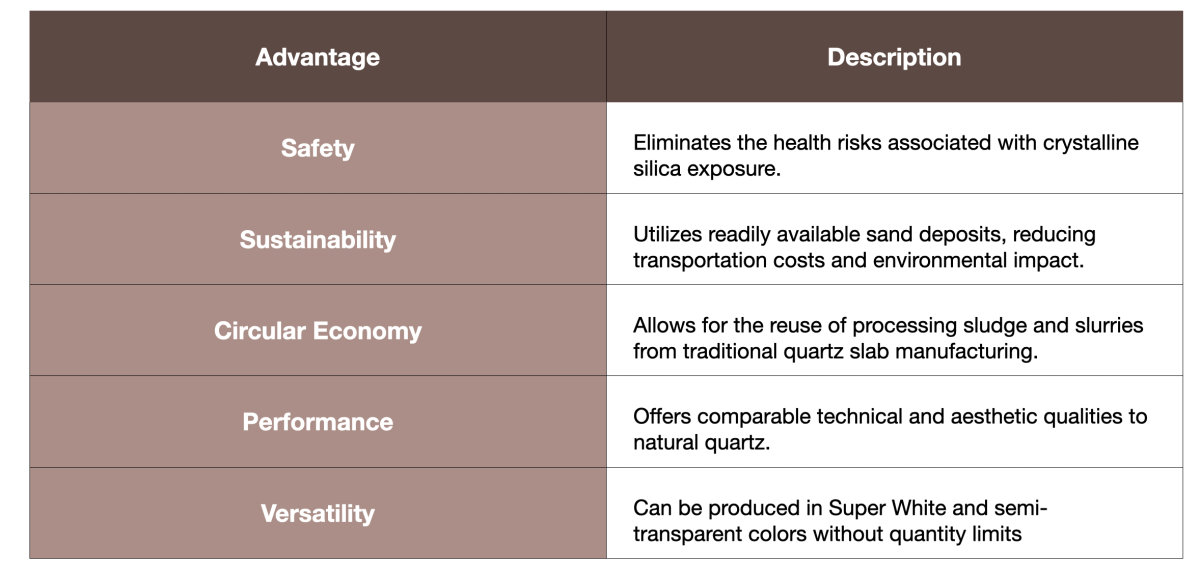
Advantages of Bioquartz®
In addition to the advantages outlined above, Bioquartz® offers several specific benefits over traditional quartz:
- Enhanced Health and Safety: Bioquartz® is completely free of crystalline silica, eliminating the risk of silicosis and other respiratory illnesses associated with quartz dust exposure. This makes it a safer choice for workers and contributes to a healthier work environment [6].
- Improved Sustainability: Bioquartz® is produced using readily available sand deposits, reducing the need to quarry and transport large quantities of quartz. This reduces transportation costs, minimizes environmental impact, and supports sustainable sourcing practices [6].
- Compatibility with Existing Processes: Bioquartz® can be seamlessly integrated into existing vacuum vibro-compression production processes, making it a convenient and cost-effective alternative for manufacturers [6].
History of Bioquartz® Development
Breton S.p.A., a leading manufacturer of stone processing machinery and technology, has been at the forefront of developing innovative and sustainable solutions for the industry [2]. Over the past decade, Breton and its Institute of Technology (BIT) have prioritized operator safety and waste reduction as strategic goals, leading to the development of Bioquartz®6. This commitment arose in response to the growing concerns surrounding the health risks associated with crystalline silica [4]. Breton has invested significant resources in research and development to create a viable alternative to quartz. They have designed and installed a state-of-the-art industrial plant for the production of Bioquartz®, enabling customers to conduct industrial trials and produce silica-free surfaces [2].
Scientific Research on Bioquartz®
While there is limited scientific research specifically focused on Bioquartz® as a manufactured material, there are studies that explore the formation of quartz in natural settings. For example, research has investigated the precipitation of biogenic quartz (bioquartz) from pore waters that have become supersaturated due to the dissolution of biogenic opal [9]. This research, while not directly related to the industrial production of Bioquartz®, provides valuable insights into the properties and behavior of quartz in different environments.
Environmental Impact of Bioquartz®
Bioquartz® offers several environmental benefits compared to traditional quartz:
- Reduced Transportation: The use of readily available sand deposits reduces the need to transport ground quartz from distant quarries, minimizing transportation costs and associated pollution. This also contributes to a lower carbon footprint and reduced reliance on fossil fuels [2].
- Waste Reduction: The production process allows for the reuse of processing residues from traditional quartz slab manufacturing, contributing to a circular economy and minimizing waste. This reduces the need for landfill space and promotes resource efficiency [7].
- Elimination of Crystalline Silica Dust: Bioquartz® eliminates the generation of crystalline silica dust during the fabrication process, reducing the environmental impact associated with this hazardous material. This protects both workers and the environment from potential harm [5].
Future Developments and Applications
Bioquartz® is a relatively new material, but it has the potential to significantly impact the engineered stone industry and beyond. Future developments may include:
- Wider Adoption: As awareness of the health risks of crystalline silica grows and regulations become stricter, the demand for Bioquartz® is expected to increase, leading to wider adoption in the construction and design sectors.
- New Applications: The unique properties of Bioquartz® may lead to its use in other applications beyond engineered stone, such as ceramics, glass, and other industrial materials. This could further expand the market for Bioquartz® and contribute to its overall sustainability.
- Enhanced Sustainability: Further research and development may focus on optimizing the production process to further reduce the environmental impact of Bioquartz®. This could involve exploring new energy sources, minimizing water consumption, and improving waste management practices.
Bioquartz® represents a significant advancement in the engineered stone industry. By eliminating crystalline silica, it offers a safer and more sustainable alternative to traditional quartz. With its comparable technical and aesthetic qualities, Bioquartz® is poised to become the material of choice for manufacturers and consumers seeking to prioritize health, safety, and environmental responsibility.